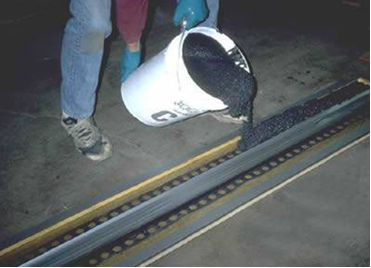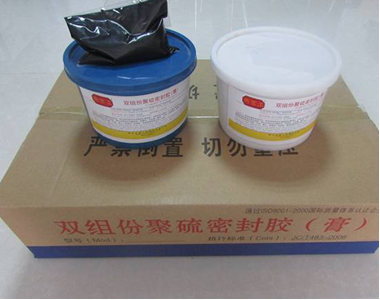

Two-component polysulfide sealant, as known as a two-component, non-sag, premium polysulfide sealant, which is also called polysulfide sealant for building made up of liquid polysulfide rubber, and add tackifying resin, vulcanizing agent, accelerant and fortifier into it. It contains two components and it can vulcanize and crosslink by itself at room temperature. The two components have clear color difference, which makes the mixing more convenient. It can keep good air tightness and water resistance in continuous vibration and temperature changes. In addition, it has a good bonding effect for metal, concrete and other materials.
Table 1: Advantages and Disadvantages of Two-component Polysulfide Sealant
|
Advantages |
Disadvantages |
|
Better water resistance. Better physical properties, recovery adhesion, peel
adhesion, and tensile adhesion. Best air tightness among all the sealants. Can maintain flexibility over a wide temperature range. Can resistant water, oils, grease, most solvents, mild
acids and alkalis. Cost lower than one component sealant. |
Requires mixing, but easily to mix. Light colors be a problem. Limited filling life, and very short filling life at 100
°F. Slight odor. Poorer UV resistance compared with urethane and silicones. Need primers for porous substrates. |
Product specifications
Material: Liquid polysulfide rubber.
Color: Component A is white and component B is black, and the mixture is black.
Classification:
According to flowability: self-leveling and non-slumping.
According to movement: ability 20 and 25.
According to tensile modulus: low modulus (LM) and high modulus (HM).
Packaging & Delivery
Net Weight: 750 g/piece × 20 pieces, or packed as customers' requirements.
Packaging Details: Packed with plastic buckets and then on pallet.
Delivery Time: Shipped in 7 days after payment.
Shelf life: 12 months.
Table 2: Technical Properties of Two-component Polysulfide Sealant
|
Projects |
Indicators |
|
Density (g/cm3) |
1.25 ± 0.1 |
|
Dry Time |
≤ 24hrs |
|
Storage Time |
≥ 2hrs |
|
Elastic Recovery Rate |
≥ 70% |
|
Tensile Bond |
No damage |
|
Tensile Bond in Water |
No damage |
|
Cold/Hot Pressing Adhesive |
No damage |
|
Mass Loss Rate |
≤ 5% |
|
Executive Standard |
JC/T483-2006 |