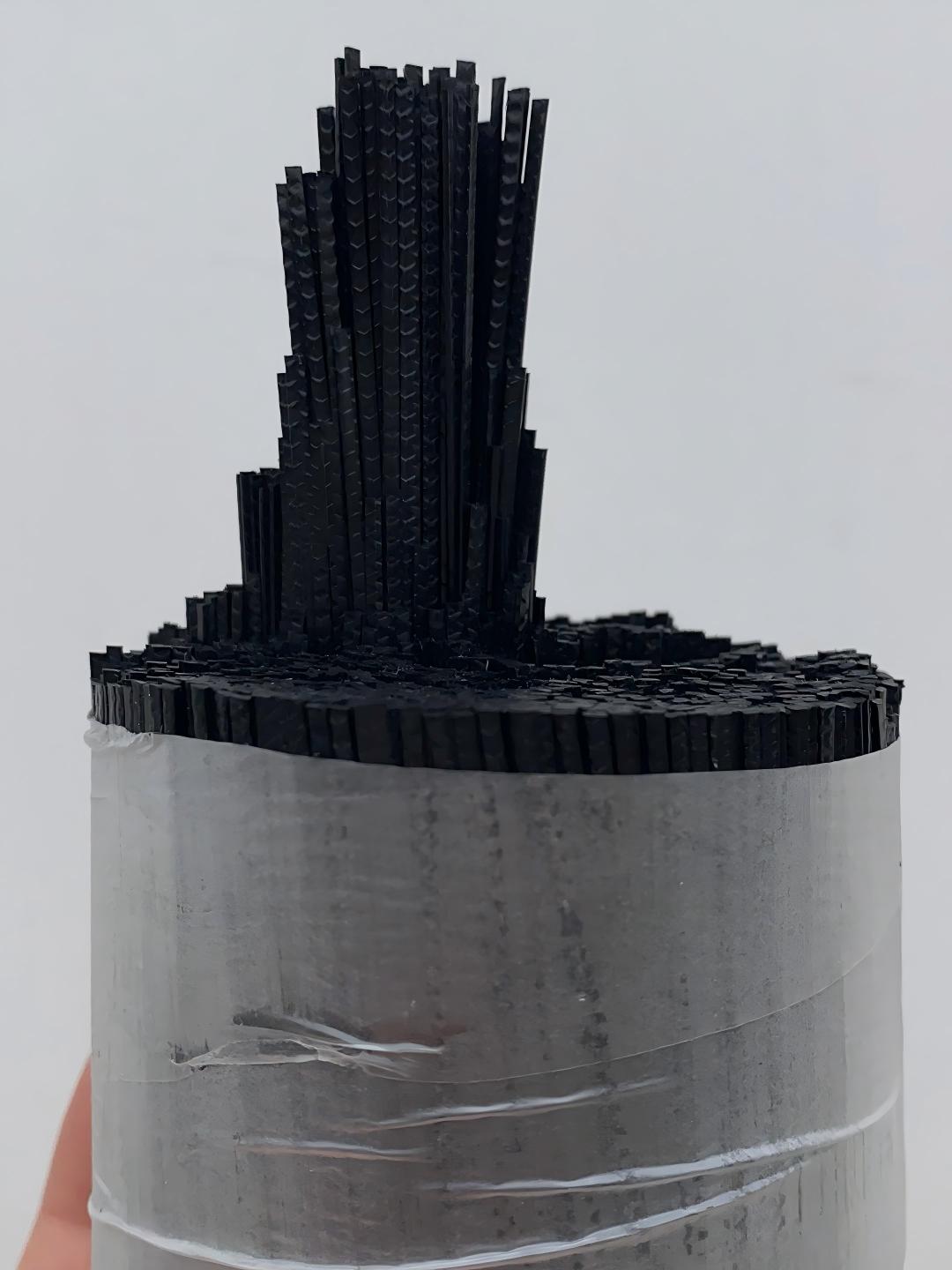

DETAILED BREAKDOWN
FOR MACRO PP FIBER:
1. MACRO
This refers to the size and
scale of the fiber.
Macro-fibers are large, typically over
0.3 mm in diameter and several inches long. They are visible to the naked eye
and provide "bridging" capacity across cracks that have already
formed.
This contrasts with Micro-fibers,
which are very fine, hair-like fibers used primarily to reduce plastic
shrinkage cracking in the first few hours after concrete is poured.
2. PP (Polypropylene)
This is the base material the
fiber is made from. Polypropylene is a popular plastic polymer chosen for its
key properties:
Chemically Inert: It does not react
with water, alkalis, or acids, making it highly durable in the harsh
environment of concrete.
Corrosion Resistant: Unlike steel, it
will never rust.
High Melting Point: It can withstand
the heat generated during concrete curing.
Low Cost: It is an economical choice
for large-scale construction projects.
3. FIBER
In this context, it's a synthetic,
discontinuous reinforcement. This means:
Synthetic: Man-made from plastic.
Discontinuous: It comes in individual
pieces (like billions of tiny hairs) mixed randomly throughout the concrete, as
opposed to a continuous mesh or rebar grid.
Reinforcement: Its primary job is to
improve the concrete's mechanical properties.
PRIMARY
FUNCTION:
The main purpose of Macro PP Fiber is
to replace or supplement traditional steel mesh (welded wire fabric) as
secondary reinforcement in concrete slabs-on-ground (like industrial
floors, pavements, and warehouses).
It provides three key
benefits:
Crack Control: This is its primary
job. When micro-cracks in concrete begin to widen, the macro-fibers bridge
across the crack, holding the concrete together and transferring stress. This
prevents the cracks from becoming large and problematic.
Toughness &
Impact Resistance: Fibers increase the energy
absorption capacity of concrete. The concrete becomes more resistant to
shattering, abrasion, and impact from heavy loads or dropped objects.
Spalling Resistance: In concrete surfaces, fibers help hold the material together,
reducing the risk of chips and fragments breaking off the surface.
SPECIFICATION:
|
SrNo |
Test Item |
Unit |
Index |
|
1 |
Length |
mm |
48/55/65 |
|
2 |
Filament Diameter |
mm |
Width:1.37+/-0.1mm |
|
3 |
Density |
g/cm3 |
0.91 |
|
4 |
Tensile Strength |
Mpa |
650 |
|
5 |
Acid/Alkali resistance |
- |
Yes |
|
6 |
Elongation |
% |
15 |
|
7 |
Melting point |
°C |
170 |
|
8 |
Modulus of elasticity |
MPa |
10000 |
PACKING: 5kg/box, 1200-1300kg/pallet, 12000kg/20’ container,
24000kg/40’ container